
Evolution of Dental Clinical Ergonomics Assessments
Since 1982, following the installation of the Clinical Simulation Laboratory at the University of British Columbia, extensive research was undertaken to elucidate and demonstrate the real parameters of clinical ergonomics. Faculty members at UBC, in collaboration with the World Health Organization, the University of Maryland and several other global dental faculties launched joint projects to optimize the teaching and retention of clinical ergonomics principles as they applied to dentists, dental hygienists, and dental assistants. The core of the research was based on work begun in the 1960s and early 1970s by German, Scandinavian, and American dentists, including Dr. Daryl Beach (a visionary Oregon-trained dentist living and working at the time in Atami, Japan).
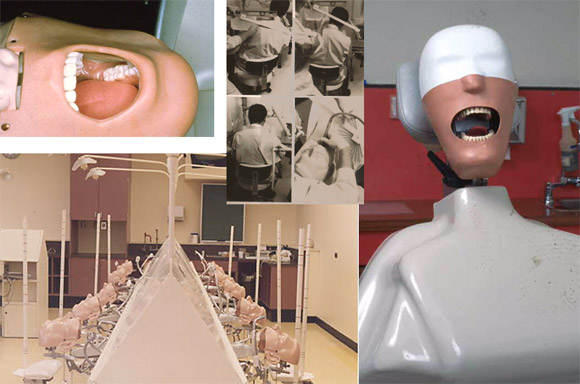
Ergonomics Simulation Lab
By the late 1980s, Dr. Rucker at UBC and Dr. Michael Belenky at the University of Maryland were entreated by dental hygiene faculty on many parts of the continent to engage in advanced dental hygiene-directed ergonomic education and to collaborate on further research specifically directed toward occupational health of dental hygienists. Dr. Susanne Sunell has continued to provide exceptional research and service expertise, as well as promoting the interests of dental hygiene educators who would increasingly incorporate and integrate the principle of balanced clinical ergonomics into dental hygiene practice.
Beginning in 1987, Dr. Rucker and the late Dr. Belenky were called upon to share information with dental schools, dental hygiene programs, and other organizations and institutions regarding equipment settings and educational formats for integration of optimized clinical ergonomics into the education of young and emerging practitioners.

Dr. Lance Rucker and Dr. Michael Belenky
In 1988, Dr. Rucker began his seminal investigation into issues of declination angle and its role in optimized design and adjustment for surgical telescopes (also called “loupes”), which has continued to the present in cooperation with many industrial collaborators. Ophthalmologist Dr. Craig Beattie provided consistent and ongoing expertise throughout this period, making him an invaluable consultant for those devoted to understanding dental clinical ergonomics.

Surgical Telescopes In Use
Drs. Rucker and Sunell organized a joint project in the mid-1990s, funded by the Workers’ Compensation Board of B.C., in which dentists and dental hygienists were evaluated for the reduction in work-related risks associated with preventive ergonomic training and the use of surgical telescopes in practice. This project, the results of which have been published widely since the study was completed in 2001, identified statistically significant ergonomic risk factors found in the practice profiles of dental clinicians, as well as specific risk factors associated with certain equipment layouts.
Since 1996, Dr. Rucker has been called upon to assess (using the Ergonomic Practice Assessment protocol) and help (vis-à-vis ergonomic rehabilitation and equipment layout design) dental health clinicians of all ages, many of whom have been involved in acute trauma (motor vehicle accidents and sports-related injuries are most common), or who have been injured by cumulative trauma disorders (soft tissue musculoskeletal injuries). In this capacity, Dr. Rucker has worked with most major disability insurance corporations for dental professional clients, including Berkshire Life, Provident/Paul Revere, Great-West Life, Blue Cross, Sun Life, the Insurance Corporation of B.C., Mutual of New York, Unum, Canada Life, ManuLife, Imperial Life, and Desjardins Financial Security. He has worked closely with other rehabilitation personnel (OTs, PTs, and physiatrists) when he is contracted to consult during rehabilitation of injured professionals.
Since 1990, Dr. Rucker has worked closely with many of the world’s experts in the broader spectrum of workplace injuries. He has conducted research and engaged in product development for general office workplace ergonomics as well.

ErgoLogic Keyboard
Since 1998, Dr. Rucker has been involved in medical-legal reviews of the ergonomic practices of injured dental, dental hygiene, and dental assistant claimants.
The important facts which have emerged from the work of the Dental Clinical Ergonomics Consultants Group and fellow researchers during the past 28 years are clear:
 Consistent from studies in both the U.S. and Canada, 67% of the members of the dental profession sustain work losses each year from work-related injuries or disorders.
- Given what we now know, many (if not most) of these losses are unnecessary.
- Profiles of work habits, dental operatory equipment set-up, and equipment utilization patterns can be utilized to assess and map risk profiles for individual professionals and individual operatory work settings.
- These high-risk profile elements can be altered and risks reduced or eliminated by rearrangement or revised specification of operatory equipment, and by training or retraining professionals to optimize their utilization of their clinical operatories.
- The foregoing observations and comments apply (and in many cases to an even greater extent) to the statistics and prognoses for dental hygienists.
Summary
For the past 28 years, Dr. Rucker has worked with teams of researchers, educators, and specialists in clinical assessment and rehabilitation for dentists, dental hygienists, and dental assistants in professional offices and government facilities across the U.S and Canada.
Dr. Rucker has extensive credentials and resources for his expertise in dental clinic ergonomics which include the following:
- Has an international reputation as an invited lecturer and keynote speaker for topics related to dental ergonomics.
- Has taught (through Continuing Education courses) thousands of dentists and dental hygienists and other dental office personnel to understand and utilize the skills of optimal dental clinical ergonomics.
- Is a citizen of both the United States (where he was born) and Canada (since 1978).
- Has travelled across the U.S. and Canada to conduct Ergonomic Practice Assessments.
- Is a former dentist licensed in the United States (California) and in Canada (British Columbia) for 34 years until his retirement from the University of British Columbia Faculty of Dentistry in 2017.
- Writes expert medical-legal reports and has given expert testimony in courts in the U.S. and Canada.
- Has written many scholarly articles as well as general professional journal articles about his realm of special expertise in clinical ergonomics.
- Conducts site visit evaluations of many private and institutional dental clinic practice settings.
- Performs Ergonomic Practice Assessments in the professional’s own private dental offices using sophisticated patient simulation equipment. When the professional being ergonomically assessed has already retired from practice in the wake of impairment, the Ergonomic Practice Assessment is sometimes performed by prior arrangement in another private office in the region, or at a regional dental school facility.
- Oversees recommended interventions, when equipment adjustment or modification has been indicated, or when specialized ergonomic training/retraining has been indicated) in the professional’s own private dental offices, also using sophisticated patient simulation equipment.
 Ergonomics Dental